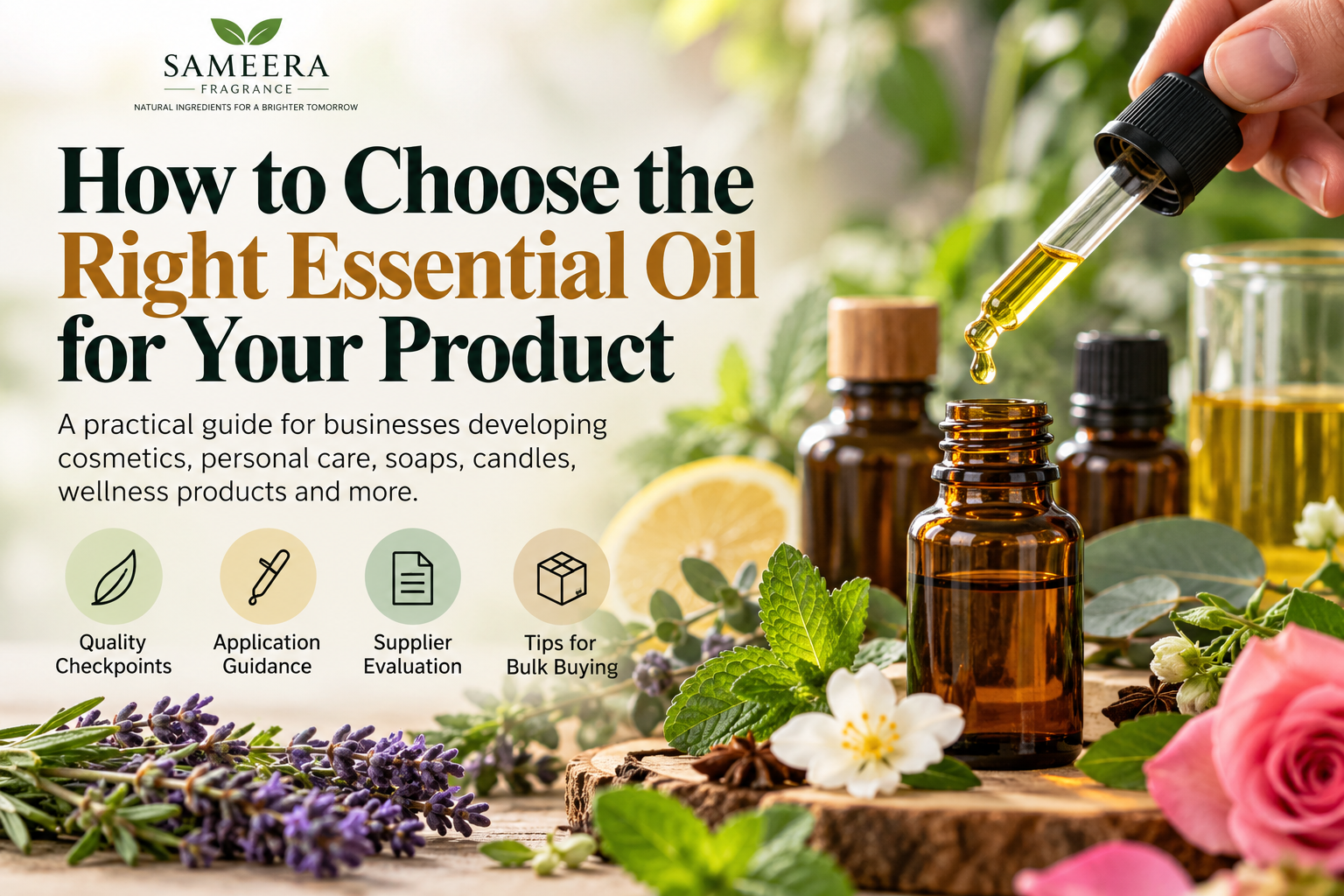
Choosing an essential oil is not simply about finding an aroma you like. If you are developing cosmetics, personal-care products, soaps, candles, wellness products, or other formulations, the oil needs to suit the application, formulation, quality requirements, and intended customer experience.
With so many essential oils and suppliers available, it is easy to focus only on price or fragrance. A better approach is to evaluate the oil from several angles before placing a bulk order. This guide explains what to check, what questions to ask a supplier, and how to test an essential oil before using it in your finished product.
Quick Answer: What Should You Check Before Buying an Essential Oil?
Start with the intended application. Then evaluate the botanical identity, extraction method, aroma profile, physical characteristics, documentation, sample performance, packaging, storage requirements, and supplier consistency.
Most importantly, do not assume that the strongest-smelling or most expensive oil is automatically the right choice. The correct essential oil is the one that fits your product and performs consistently within your formulation.
1. Start With Your Product, Not the Essential Oil
One of the easiest mistakes is choosing an oil first and deciding how to use it later. Instead, start by understanding your finished product.
Ask yourself:
- What product are you making?
- Will the oil be used on skin, hair, in a diffuser, or in another application?
- Will the product be washed off or left on the skin?
- Will it be exposed to heat during manufacturing?
- Does the formulation contain water, oil, alcohol, or other ingredients?
- What kind of aroma are you trying to achieve?
These questions help narrow down the appropriate oil and its intended use. An oil that works well in one type of formulation may not automatically be suitable for another.
2. Check the Botanical Name
Common names can sometimes be confusing. A botanical name gives you a much clearer way to identify the plant material.
For example, “Lavender Oil” is a common product name, but the botanical identity and source can provide additional information about what you are actually purchasing.
When comparing suppliers, ask for the botanical name rather than relying only on the commercial name printed on a quotation or product list.
Keep the botanical name, country or region of origin where relevant, batch information, and supplier documentation together in your purchasing records.
3. Understand How the Oil Was Obtained
Extraction or production method can influence the resulting aromatic profile and the characteristics of the material.
Common methods include:
- Steam distillation: Commonly used for many aromatic plant materials.
- Cold pressing: Frequently associated with citrus oils obtained from the peel.
- Solvent extraction: Used for certain aromatic materials where conventional distillation may not be appropriate.
- CO₂ extraction: Used for selected botanical materials and can produce extracts with different characteristics from traditional distillation.
The important point is not that one method is universally “best.” The suitable method depends on the botanical material, the desired product characteristics, and the intended application.
4. Smell the Sample Before You Buy in Bulk
This sounds obvious, but it is one of the most useful steps for a B2B buyer.
If possible, request a representative sample before committing to a large quantity. Evaluate the aroma in a controlled way and compare it with your product requirement.
When evaluating the aroma, consider:
- Initial impression
- Freshness or character
- Intensity
- Natural variation
- Dry-down or later-stage aroma
- Compatibility with your other ingredients
Also remember that an essential oil can smell different when evaluated on a blotter, in a carrier, and inside a finished formulation.
5. Don’t Judge Quality Only by Aroma Strength
A common buying mistake is assuming that a stronger smell means better quality.
Aroma intensity is only one characteristic. Quality evaluation should consider the identity of the material, its specifications, analytical or batch documentation where applicable, handling, storage, and performance in the intended application.
A good supplier should be able to explain what material they are supplying rather than simply describing it as “strong,” “premium,” or “100% pure.”
6. Ask for the Right Documentation
Documentation becomes increasingly important as your purchase volume grows. Depending on the product and application, you may need different technical or quality documents.
Depending on the material, ask whether the supplier can provide relevant documents such as:
- Certificate of Analysis (COA)
- Specification sheet
- Safety Data Sheet (SDS), where applicable
- Batch or lot information
- Allergen information, where relevant
- Analytical information such as GC/MS, where applicable
Documentation requirements vary by product and end use. If your product is regulated or intended for a specific market, confirm the applicable requirements before purchasing.
7. Consider the Country and Source of the Raw Material
Botanical materials can vary according to species, growing conditions, harvest, processing, and origin.
This does not mean that one country automatically produces a better oil than another. Instead, origin can be one useful part of your traceability and product specification process.
For products where origin matters to your brand story or specification, discuss the expected source with your supplier before ordering.
8. Check How the Oil Performs in Your Actual Formula
A sample can smell excellent by itself and still behave differently inside your finished product.
Before approving a bulk purchase, test the oil in the actual formulation whenever possible.
For example, check:
- Aroma after mixing
- Appearance
- Stability during storage testing
- Interaction with other ingredients
- Performance after processing
- Changes after exposure to heat or light, where relevant
This small testing step can prevent an expensive bulk-order problem later.
9. Think About Packaging and Storage
Essential oils are concentrated aromatic materials and should be handled and stored according to the product’s specific requirements.
Ask your supplier about recommended packaging, storage conditions, shelf life, and handling requirements.
For bulk buyers, packaging should also be practical for transportation, storage, dispensing, and production use.
10. Compare Suppliers Beyond Price
Price is important in B2B purchasing, but it should not be the only comparison point.
| What to Compare | Why It Matters |
|---|---|
| Product identity | Helps ensure you are comparing the same type of material. |
| Sample | Lets you evaluate the material before bulk purchasing. |
| Documentation | Supports quality and purchasing decisions. |
| Batch consistency | Important for repeat production. |
| MOQ | Should match your purchasing requirements. |
| Packaging | Important for storage, transport, and production. |
| Technical support | Useful when you are developing or modifying a formulation. |
Essential Oil Buying Checklist
Before placing your order, use this simple checklist:
- ☐ Confirm the exact product name
- ☐ Check the botanical name where applicable
- ☐ Understand the extraction or production method
- ☐ Request a sample
- ☐ Evaluate the aroma
- ☐ Test the sample in your actual application
- ☐ Ask about specifications and available documentation
- ☐ Confirm MOQ and packaging
- ☐ Discuss storage and shelf-life information
- ☐ Confirm expected batch consistency for repeat orders
Common Mistakes Buyers Make
Buying only because the price is low
A lower quotation is not necessarily a better purchase if the material does not meet your application or consistency requirements.
Skipping the sample stage
For a significant bulk order, testing a representative sample first is usually a sensible purchasing step.
Comparing products only by their names
Two products with similar commercial names may have different botanical identities, origins, specifications, or production methods.
Ignoring storage
Appropriate storage is part of maintaining the expected characteristics of an aromatic material after purchase.
Not discussing repeat supply
If the ingredient is going into a product you manufacture regularly, ask how the supplier manages consistency across batches.
How Sameera Fragrance Approaches B2B Essential Oil Requirements
At Sameera Fragrance, we understand that a business buying essential oils is usually not looking for a bottle simply because it smells good. The material needs to fit a real product, a production process, a budget, and an ongoing supply requirement.
Our B2B discussions can therefore start with the application, required quantity, preferred product characteristics, and sampling requirement. This helps buyers evaluate the material before moving toward larger quantities.
For businesses developing a new product or looking for a regular bulk supplier, discussing the application before finalizing the material can make the purchasing process much smoother.
Frequently Asked Questions
How do I know which essential oil is right for my product?
Start with the product application, formulation, desired aroma, processing conditions, and required specifications. Then test a representative sample in the actual product before placing a bulk order.
Should I ask for an essential oil sample?
Yes. Sampling is especially useful before a large B2B purchase because it allows you to evaluate aroma, compatibility, and performance in your application.
Is a stronger-smelling essential oil better?
Not necessarily. Aroma strength alone does not establish overall quality. Product identity, specifications, documentation, handling, and application performance should also be considered.
What documents should I request from an essential oil supplier?
Depending on the product and intended application, you may request documents such as a COA, specification sheet, SDS, batch information, allergen information, or relevant analytical data.
How should essential oils be stored?
Follow the supplier’s product-specific storage recommendations. In general, appropriate protection from unsuitable heat, light, air exposure, and contamination is important, but exact requirements can vary by material.
Can I buy essential oils in bulk from Sameera Fragrance?
Sameera Fragrance supplies fragrance and aromatic products for B2B requirements. If you have a specific oil, application, quantity, or sampling requirement, contact the team to discuss your requirement and available options.
Looking for the Right Essential Oil for Your Product?
Tell us what you are manufacturing, which essential oil you are considering, and the approximate quantity you need. The Sameera Fragrance team can help you discuss the appropriate product and sampling requirements.